of the storage projects' ₹97,600 crore cost the Centre will pay
India's ₹14,500 crore storage scheme is mostly pumped hydro
On 4 November 2026 the Union Cabinet approved ₹14,500 crore of support for 92 GWh of grid storage, paid out from FY27 to FY31. It reads like a battery push, yet batteries get 30 GWh. The bigger share, 60 GWh or 65%, goes to pumped hydro.
Storage is how solar power reaches the evening: store it while the sun shines, release it after dark. A battery does that with cells. Pumped hydro uses water, pumped up to a high reservoir when power is cheap and let back down through turbines when it is needed. Until now the Centre paid only for batteries, ₹3,760 crore from 2023 and ₹5,400 crore from June 2025.
Each unit also gets less. The ₹14,500 crore covers about 15% of the ₹97,600 crore the projects should cost, or ₹15.8 lakh per MWh, against ₹18 lakh in 2025 and ₹28.5 lakh in 2023. Cheaper batteries explain much of that: the 2023 scheme grew 3.3x in capacity with no new money. The release does not split the money between pumped hydro and batteries.
So India's biggest storage scheme yet is mostly a bet on water, and the Centre pays about half the 30% of cost the 2023 scheme allowed. The power distribution companies and developers who win the bids carry the rest. Even built in full, the scheme is 22% of the 411 GWh of storage India needs by 2031-32.
Pumped hydro is 60 of the scheme's 92 GWh
Storage the Cabinet's November 2026 scheme supports, in GWh. Batteries get less than a third of it.
GWH OF STORAGE
- Pumped hydro60 65.2%
- Batteries30 32.6%
- Other technologies2 2.2%
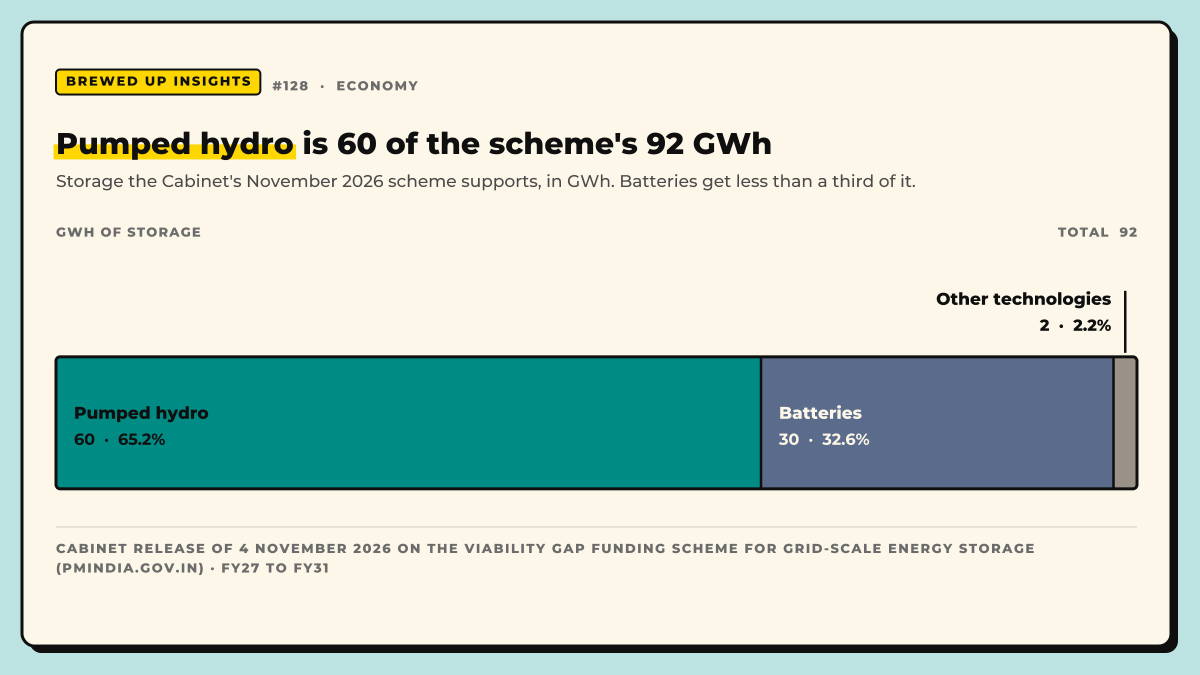
Cabinet release of 4 November 2026 on the viability gap funding scheme for grid-scale energy storage (pmindia.gov.in) · FY27 to FY31
Each MWh of storage gets less central money
Central support divided by the storage each scheme covers, in ₹ lakh per MWh. The 2026 figure mixes pumped hydro with batteries.

₹ LAKH PER MWH
Each figure is the scheme's budget divided by its capacity. The 2023 scheme also capped each project at ₹46 lakh per MWh or 30% of cost, whichever was lower.
Ministry of Power releases on PIB, 3 April 2025 and 1 December 2025; Cabinet release of 4 November 2026 (pmindia.gov.in) · Schemes of 2023, 2025 and 2026
The Centre pays about 15% of the storage bill
Expected cost of the 92 GWh in the November 2026 scheme, in ₹ crore. The projects that win the bids carry the rest.
₹ CRORE, EXPECTED COST
- Central support14,500 14.9%
- Left to the projects83,100 85.1%
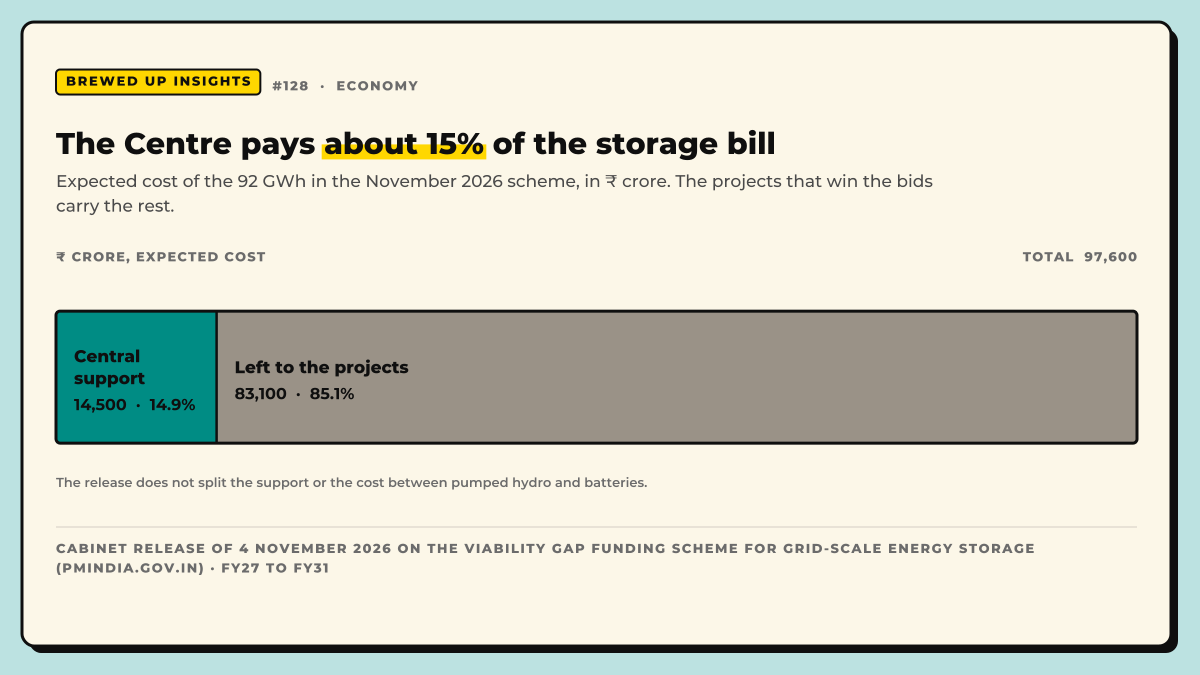
The release does not split the support or the cost between pumped hydro and batteries.
Cabinet release of 4 November 2026 on the viability gap funding scheme for grid-scale energy storage (pmindia.gov.in) · FY27 to FY31
Sources
- Prime Minister's Office (pmindia.gov.in), 4 November 2026: Cabinet approves Rs.14,500 crore Viability Gap Funding Scheme for 92 GWh of grid-scale energy storage
- PIB, Ministry of Power, 3 April 2025: Viability gap funding for battery energy storage systems (Lok Sabha reply)
- PIB, Ministry of Power, 1 December 2025: India's power capacity hits 5.05 lakh MW (with the June 2025 battery scheme)