of black mass India imported in FY26, against no exports
India bans black mass exports, which were already zero
On 10 November 2026, India banned exports of lithium-ion battery black mass, the mix left when used batteries are taken apart and shredded, before the metals in it are pulled out. Yet the commerce ministry's own trade data show no exports under that line in any year from FY23 to FY26, while 836 tonnes came in during FY26.
So India is stopping its battery metals from leaving? Under this line, none were leaving. The notice from the DGFT, the commerce ministry's trade office, moves 1 code, unsorted battery scrap with no lead, cadmium or mercury, from free to prohibited. The code for the same scrap sorted by chemistry is not in it, and it showed no exports in FY25 or FY26 either.
The flow ran the other way. Those imports cost ₹37.60 crore, up from 43 tonnes a year before, and 70% of the weight came from the Netherlands. Then, from April to October 2026, none came in. For scale, India imported ₹4,853 crore of spent lead-acid batteries in FY26, 129x the black mass.
The ban fits a plan that came first. In September 2025 the Cabinet approved a ₹1,500 crore scheme for plants that pull critical minerals out of e-waste and battery scrap, and it pays for "actual extraction", not for plants that only make black mass.
So on the official numbers, the ban costs almost nothing today. It seems to be about tomorrow's black mass: as more lithium-ion batteries wear out, plants that only shred them get no subsidy and can no longer sell unsorted black mass abroad, so their buyers will be the Indian extractors the scheme pays for.
India took black mass in and sent none out
Lithium-ion battery black mass traded under HS 8549 1400, in tonnes, by financial year. Imports jumped in FY26, and no exports were recorded in any of the 4 years.

TONNES
ExportsImports
HS 8549 1400 is unsorted battery scrap with no lead, cadmium or mercury, which the DGFT calls black mass. Its export was banned on 10 November 2026.
Department of Commerce, TradeStat, exports and imports of HS 85491400; DGFT Notification 49/2026-27 · FY23 to FY26
70% of India's black mass imports came from the Netherlands
Where India's 836 tonnes of black mass imports came from in FY26, in tonnes. The Netherlands and the US sent almost all of it.
TONNES
- Netherlands583 69.7%
- US208 24.8%
- Poland and Switzerland45 5.4%
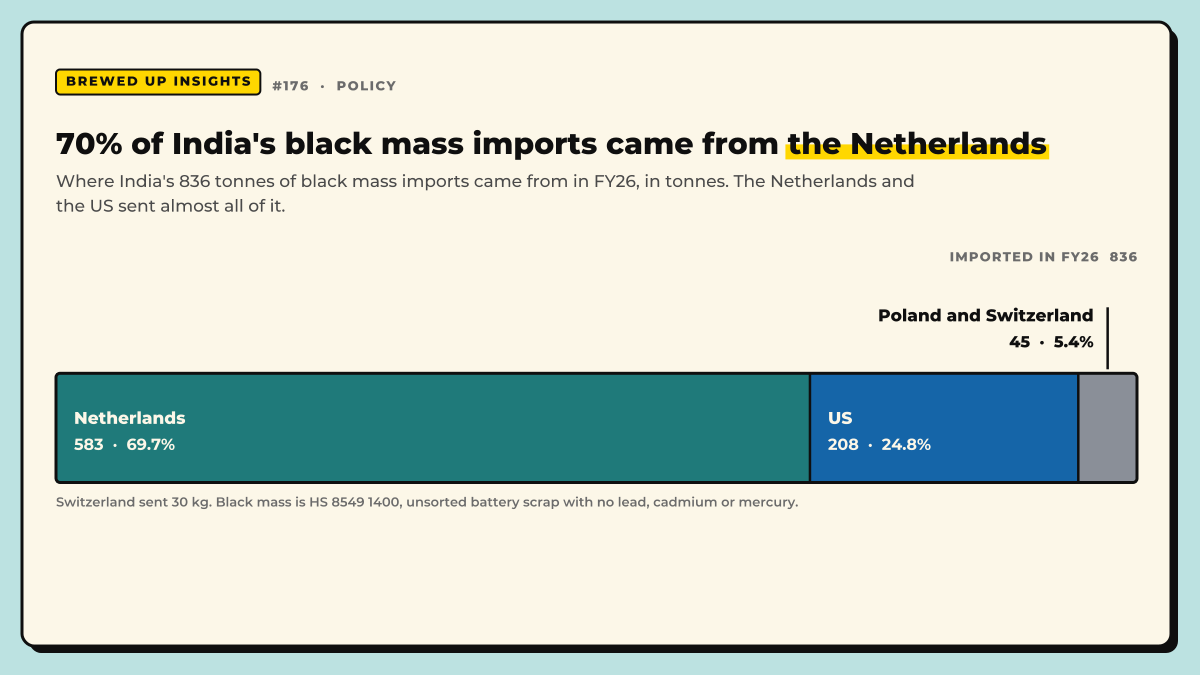
Switzerland sent 30 kg. Black mass is HS 8549 1400, unsorted battery scrap with no lead, cadmium or mercury.
Department of Commerce, TradeStat, imports of HS 85491400 by country · FY26 (April 2025 to March 2026)
India's lead battery scrap imports were 129x its black mass
India's imports of 2 kinds of battery scrap in FY26, in ₹ crore. Used lead-acid batteries were nearly all of it.

₹ CRORE OF IMPORTS
Department of Commerce, TradeStat, imports of HS 85491100 and 85491400 · FY26 (April 2025 to March 2026)
Sources
- DGFT, Notification No. 49/2026-27 of 10 November 2026: export policy of ITC (HS) 85491400 (lithium-ion battery black mass) from Free to Prohibited (PDF, scanned)
- Department of Commerce, TradeStat (EIDB), exports commodity-wise: HS 85491400 and 85491300, 2022-23 to 2025-26
- Department of Commerce, TradeStat (EIDB), imports commodity-wise: HS 85491400 and 85491100, 2022-23 to 2025-26
- Department of Commerce, TradeStat (EIDB), imports of HS 85491400 by country, 2025-26
- Department of Commerce, TradeStat (monthly), imports of HS 85491400, April to October 2026
- Cabinet decision of 3 September 2025: Rs 1,500 crore incentive scheme for critical mineral recycling (PM India)
- National Critical Mineral Mission, FAQs on the Critical Mineral Recycling Incentive Scheme