minimum per investor in a securitisation note, now at every resale too
RBI bars small investors from buying securitisation notes on resale
The RBI's ₹1 crore minimum for securitisation notes was meant to keep small investors out, but it only applied when a note was first sold. From 1 April 2027 it covers every resale too.
A securitisation note is a bond paid from a pool of loans. A bank or an NBFC (a lender that is not a bank) sells loans it has made to a trust, which issues the notes and passes the borrowers' repayments on to their holders.
So small investors were kept out already? Only at the first sale. The RBI now says its aim was always to keep them out of resales too, which the rule as written did not do.
SEBI, which oversees how such notes are listed and traded, drew the line the other way in a December 2024 board paper: a ₹1 crore floor on every transfer for notes from lenders outside the RBI, none on resale for banks' and NBFCs' notes, a large share of the market.
Both drew pushback. 68% of the replies to SEBI's consultation on the floor disagreed, and replies to the RBI said a resale floor would make notes harder to sell. The RBI said no: exchanges and depositories can enforce lot sizes.
The new rule also covers notes issued before April 2027, and all notes must be held in demat (electronic) form. A note that repays in parts may trade below ₹1 crore as it shrinks. The rules do not say how a smaller holder of an old note can sell.
So these notes become a market for big investors only, at the first sale and after. A small saver can still reach a pool of loans, but only through a fund, such as a mutual fund, that buys the notes.
More on how India borrows and lends in the Macro Brew.
RBI's ₹1 crore note floor now covers every resale

RBI securitisation directions, 2025, and amendments of 23 Nov 2026 · Nov 2025 to Apr 2027
SEBI set a resale floor first, but not for banks' notes

SEBI board paper, Dec 2024; RBI securitisation directions, 2026 · Sep 2021 to Apr 2027
Most replies to SEBI opposed the ₹1 crore floor
REPLIES
- Disagreed15 68.2%
- Agreed6 27.3%
- Partly agreed1 4.5%
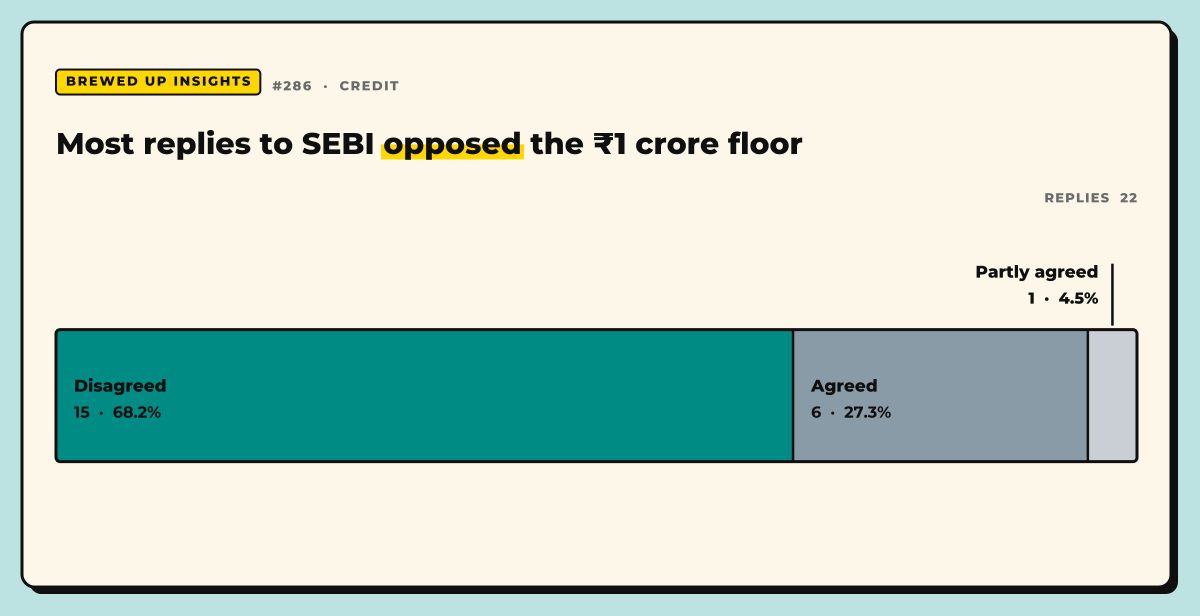
SEBI board paper, December 2024, Table No. 1, proposal 2 · Nov 2024
Sources
- RBI, Non-Banking Financial Companies - Securitisation Transactions Amendment Directions, 2026, 23 November 2026 (PDF)
- RBI, Commercial Banks - Securitisation Transactions Amendment Directions, 2026, 23 November 2026 (PDF)
- RBI press release of 23 November 2026: Reserve Bank (Securitisation Transactions) Amendment Directions, 2026
- RBI, Statement on the feedback received on the draft Securitisation Transactions Amendment Directions, 23 November 2026 (PDF)
- RBI, Non-Banking Financial Companies - Securitisation Transactions Directions, 2025, 28 November 2025, paragraph 26
- SEBI board memorandum, December 2024: Amendments to SEBI (Issue and Listing of Securitised Debt Instruments and Security Receipts) Regulations, 2008 (PDF)