households per sampled village or block kept for platform workers
PLFS to track gig workers and unpaid work at home from 2027
From January 2027, MoSPI will change the Periodic Labour Force Survey (PLFS), India's main source of employment data.
Surveyors will cover 14 households in each selected village or town block, up from 12. 2 will be reserved for households where someone worked through platforms such as Ola, Uber, Zomato, Amazon or Urban Company in the past year. This is meant to capture gig workers who were missed in earlier surveys.
This does not automatically inflate the gig worker count. The survey adjusts each household's weight to account for how many similar households it represents. The change makes gig workers easier to find and lets MoSPI ask why they took up the work and what problems they face.
The survey will also ask everyone aged 15 and above how much time they spent on unpaid cooking, cleaning and caring for family members the previous day. This will provide annual data on unpaid work, much of which is done by women.
There is one catch. January to March 2027 will combine the old and new survey samples. MoSPI will not publish the relative standard error, a measure of how much a survey estimate may vary, for these 3 months. The new sample will be fully in place only from April.
India will get better data on gig work and unpaid household work, but the first 3 monthly releases will come without a published measure of statistical uncertainty.
2 of the 14 households go to platform-worker homes
Households the PLFS will interview in each sampled village from January 2027, by group. Until December 2026 it picked 12, by schooling alone.
HOUSEHOLDS PER SAMPLED VILLAGE
- Platform homes2 14.3%
- 2 or more finished Class 104 28.6%
- 1 finished Class 106 42.9%
- None finished Class 102 14.3%
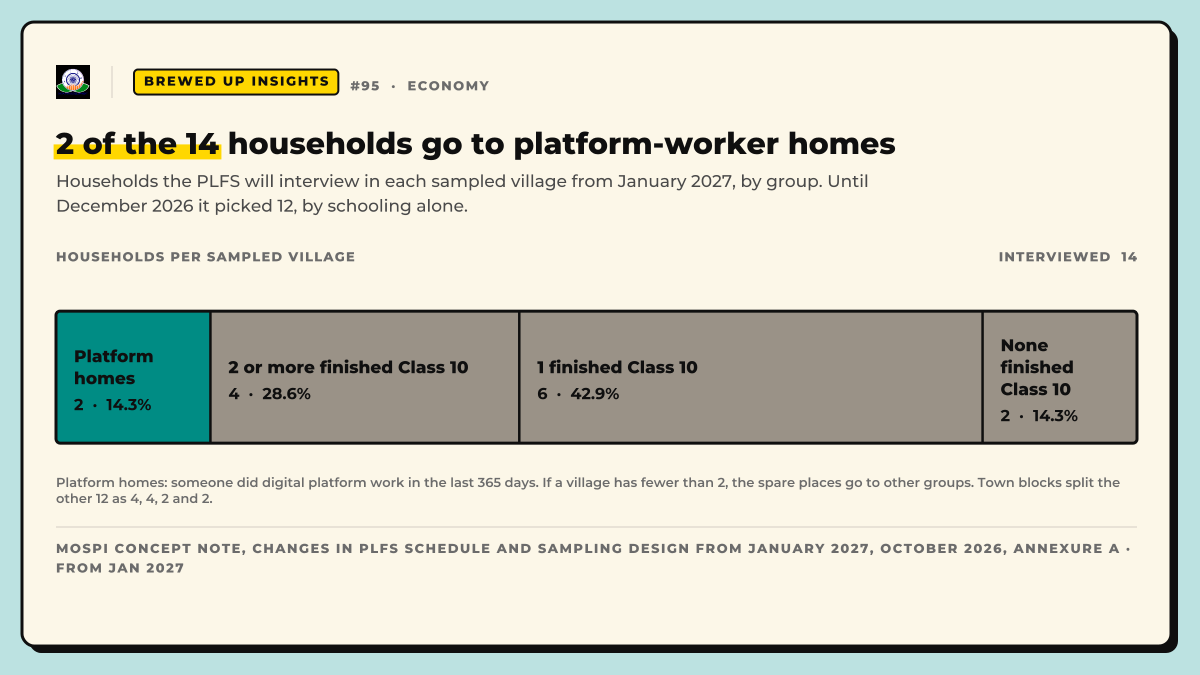
Platform homes: someone did digital platform work in the last 365 days. If a village has fewer than 2, the spare places go to other groups. Town blocks split the other 12 as 4, 4, 2 and 2.
MoSPI concept note, Changes in PLFS schedule and sampling design from January 2027, October 2026, Annexure A · From Jan 2027
The new PLFS sample takes over the monthly figures by April
Batches of villages and town blocks behind each monthly PLFS figure, the new 2027-28 sample against the old 2025-26 one. No margin of error is published for January to March.

MONTHLY BATCHES OF THE SAMPLE
New sampleRest of old sample
Each batch is a twelfth of a year's sample, interviewed 4 months running. January's figure averages the old and new samples' estimates.
MoSPI concept note, Changes in PLFS schedule and sampling design from January 2027, October 2026, Annexure A · Dec 2026 to Apr 2027